

Zanetti AI Framework™
The scientific operating model for enterprise AI.
A structured system for transforming everyday AI into controlled, governed, and scalable business execution.
No code. No new tools. Just the AI you already use, applied with far more structure, reliability, and strategic discipline.
Artificial intelligence is now part of everyday business life. Large language models can write, analyse, summarise, and generate ideas in seconds. Yet most professional use remains fragmented, inconsistent, and difficult to scale.
The Zanetti AI Framework™ was created to solve that problem.
Developed by Simone Zanetti at the Zanetti AI Institute, it is a structured operating model for helping non-technical professionals use large language models with greater control, stronger reliability, and more business value. It enables organisations to move from isolated AI interactions to governed systems of reasoning, execution, and scale.
This is not a prompt library.
It is not a software stack.
It is not a coding framework.
It is a governing architecture for AI-assisted business execution.
Why the framework exists
A deeper business problem also remains unresolved:
AI outputs are not inherently reliable.
Even when they appear strong, they may still be inconsistent, hard to validate, and difficult to audit. In real organisations, that is a structural limitation. Business use requires more than speed. It requires reliability, traceability, and accountability. Framework 4.2 addresses that directly through a governing model called The Law of Reliable AI and its Assurance System.
At the same time, much of the AI market still assumes that meaningful adoption requires technical teams, specialist tooling, or large transformation programmes.
The Zanetti AI Framework™ addresses both problems at once.
It provides a rigorous but non-technical way to apply AI immediately inside real business environments, using the systems professionals already have.
What the Zanetti AI Framework™ is
The Zanetti AI Framework™ is a structured system of complementary methodologies that governs the full lifecycle of AI-assisted business work.
It helps professionals:
construct disciplined reasoning environments
preserve validated decisions as reusable assets
transform fragmented information into AI-ready formats
convert workflows into repeatable execution systems
expand agent capabilities in a controlled and modular way
coordinate specialised agents across complex initiatives
align outputs with how people think, decide, and act
enforce assurance so AI-generated outputs are observable, validated, and auditable
The result is a more controlled way to apply artificial intelligence in business without depending on coding skills, technical infrastructure, or new software stacks.
The governing logic of the framework
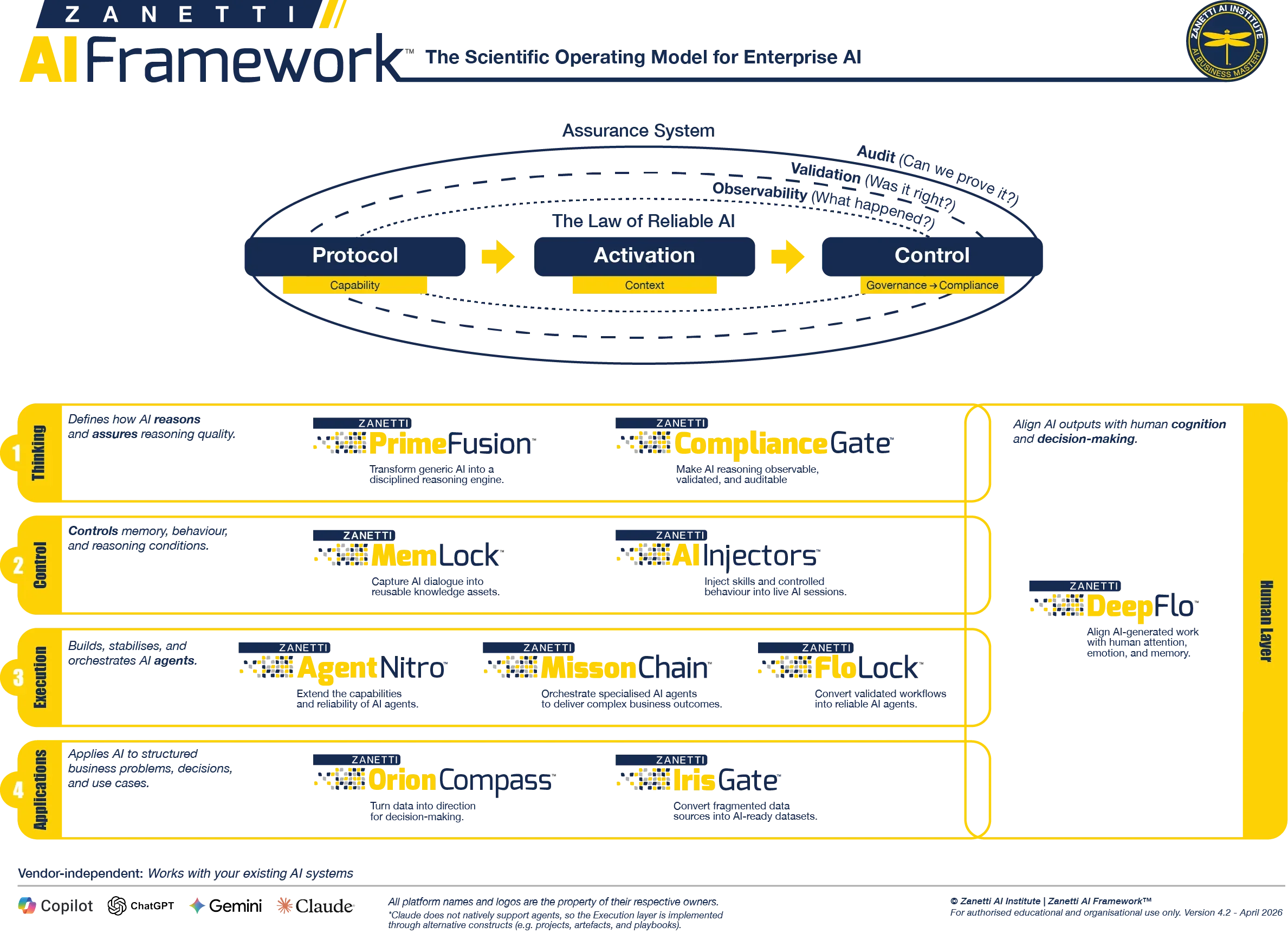
The framework is organised as a layered architecture that reflects how AI-assisted work actually unfolds in business.
It is not a rigid sequence.
It is not a fixed workflow.
It is a governed architecture made up of distinct but complementary layers.
These layers address five recurring business problems:
how reasoning is constructed
how memory, behaviour, and conditions are controlled
how execution is stabilised through agents
how AI is applied to structured business problems and decisions
how outputs are aligned with human cognition and decision-making
Across all of these layers, the same governing principles apply:
The Law of Reliable AI
Protocol → Activation → Control
The Assurance System
Observability → Validation → Audit
The methodologies of the framework
The Zanetti AI Framework™ is composed of complementary methodologies, each designed to solve a specific class of problem in AI-assisted business work.
At a high level, the framework includes methodologies for:
governing AI cognition and structured reasoning
preserving validated knowledge from AI dialogue
activating controlled behaviours inside live AI sessions
assuring outputs through observability, validation, and audit
expanding and stabilising AI agents
orchestrating specialised agents across larger initiatives
converting validated workflows into repeatable execution systems
transforming human-formatted information into AI-ready datasets
aligning communication with human attention, memory, and behaviour
Together, these methodologies turn AI from a conversational tool into a structured operating model for business execution.
Who it is for
The framework is designed for business professionals, not only technical teams.
It is relevant for:
executives
managers
consultants
analysts
marketers
operations teams
finance professionals
learning and development teams
founders and business owners
It is built on a simple premise:
Most professionals should be able to use AI effectively with the tools they already have.
That is why the Zanetti AI Framework™ is designed to work with systems such as ChatGPT, Microsoft Copilot, Gemini, and similar large language model environments, without requiring programming knowledge or technical infrastructure.
Why it matters
Without structure, AI remains a powerful but inconsistent tool.
With the Zanetti AI Framework™, it becomes a more controlled system for reasoning, execution, and scale.
That is the shift the framework is designed to create:
from prompting to governed execution
from isolated interactions to repeatable systems
from AI experimentation to enterprise-ready application
What changed in version 4.2
Version 4.2 strengthens the governing architecture of the framework.
It introduces The Law of Reliable AI, which defines the three conditions required for reliable AI-assisted work:
Protocol → Activation → Control
It also introduces the Assurance System, which defines how outputs must be assessed:
Observability → Validation → Audit
Together, these principles formalise the conditions under which AI-assisted work becomes more reliable, verifiable, and defensible in enterprise environments.
In alignment with this model, Zanetti ComplianceGate™ is introduced as the methodology that operationalises assurance by enforcing observability, validation, and audit across AI-assisted work.
Version 4.2 also strengthens the execution layer of the framework through the extension of AgentNitro™, which now more explicitly distinguishes between:
System Instructions as the orchestration layer
Playbooks as the execution layer
Canonical Artefacts as the structured knowledge layer used when complex knowledge cannot be reliably carried inside a Playbook alone
The methodologies of the Zanetti AI Framework™
Zanetti PrimeFusion™
PrimeFusion is the foundational doctrine for governing AI cognition inside the context window.
It helps professionals structure reasoning before outputs are accepted or used.
Zanetti FloLock™
FloLock is the methodology for converting validated AI-assisted workflows into locked and repeatable execution systems (Agents).
It provides the bridge between exploratory reasoning and reusable AI agents.
Zanetti DeepFlo™
DeepFlo™ is the neurocognitive methodology for aligning AI-generated outputs with human attention, memory, and behavioural response.
It applies across marketing, strategic authority, learning, and other communication environments where impact matters.
Learn more about:
[DeepFlo for Marketing]
[DeepFlo for Reputational Marketing]
[DeepFlo for Learning]
Zanetti MemLock™
MemLock is the methodology for extracting validated decisions from AI-assisted dialogue and preserving them as reusable cognitive assets.
It turns volatile conversations into structured artefacts that can be stored, reused, and re-injected later.
Zanetti AgentNitro™
AgentNitro is the methodology for expanding and stabilising AI agents through modular playbooks, soft switches, and controlled execution logic.
It enables agents to become more capable without collapsing under complexity.
Zanetti AI Injectors™
AI Injectors™ are the methodology for activating structured behaviour inside live AI sessions through portable runtime artefacts.
They allow users to inject capability, control, and workflow logic into a context window without building a full persistent agent.
Zanetti IrisGate™
IrisGate is the methodology for translating human-formatted information into canonical AI-ready datasets.
It helps transform reports, dashboards, slides, and other human-facing artefacts into formats AI can use more reliably.
Zanetti MissionChain™
MissionChain is the methodology for orchestrating specialised AI agents through sequential cognitive handoffs.
It allows complex initiatives to be executed through structured multi-agent collaboration.
Usage and citation policy
© Zanetti AI Institute. All rights reserved.
This document may be used as-is in its complete form.
If any portion of this document is quoted, reproduced, adapted, or referenced in part, it must include a clear citation to Simone Zanetti and the Zanetti AI Institute.
An acceptable citation format is:
Zanetti, S. (Year). Zanetti AI Framework™: The Scientific Operating Model for Enterprise AI. Zanetti AI Institute.
No derivative framework may be created that rebrands or repackages the Zanetti AI Framework™ without explicit written permission from Simone Zanetti.
Use of this document constitutes acknowledgement of its intellectual origin.
For enquiries, institutional collaboration, licensing, or authorised derivative use, contact us.
Limitation of use and responsibility
The Zanetti AI Framework™ and its associated methodologies, including Zanetti ComplianceGate™ and related tools, are designed to significantly improve the reliability, structure, and governance of AI-assisted work.
However, these methodologies operate on top of large language models and other probabilistic systems, which may produce incomplete, inaccurate, or contextually misaligned outputs.
Accordingly, all outputs generated using the Zanetti AI Framework™ must be subject to appropriate human review, judgement, and final approval before being relied upon in critical decisions, external communication, or operational environments.
The Zanetti AI Institute and its authors assume no liability for any decisions, actions, or outcomes arising from the use or misuse of these methodologies, whether directly or indirectly.
Frequently Asked Questions
-
The Zanetti AI Framework™ is a structured system of methodologies for using large language models in business with control, reliability, and scalability.
-
No. The framework is specifically designed so that non-technical professionals can apply it using the AI systems they already use.
-
The framework is platform-agnostic and can be applied across major large language model environments such as ChatGPT, Microsoft Copilot, Gemini, and similar systems.
-
Most AI approaches focus on tools, prompts, or technical implementation. The Zanetti AI Framework™ focuses on structure, governance, and business execution for non-technical professionals.
-
The core methodologies are PrimeFusion, MemLock, IrisGate, FloLock, AgentNitro, MissionChain, DeepFlo, and AI Injectors.
-
Yes. Each methodology solves a distinct structural problem and can be used on its own. The full power of the framework emerges when they are combined.
-
No. The Zanetti AI Framework™ and its methodologies are designed to be applied directly by professionals using the AI systems they already have.
There is no licence required to use the methodologies once they are understood.
The Zanetti AI Institute provides consulting, training, and structured programmes to help organisations implement the framework, scale AI mastery across teams, and apply the methodologies correctly in real business environments.
For clients, this includes access to:
Playbooks that expand agent capabilities
AI Injectors™ that activate structured behaviour inside live contexts
Methodology manuals that define how each component of the framework operates
Once professionals and executives are competent, they can apply the Zanetti AI Framework™ independently within their organisation.